

Every pond with fish runs on oxygen, and on Long Island the two hardest times for it are a hot August night and a frozen January week. A pond aerator is the simplest protection for both. This guide explains when a pond really needs one, how an air pump compares with a waterfall or fountain, where the air stone goes in each season and what size to buy.
If your pond has fish, it will almost always benefit from a pond aerator, and it needs one if you keep koi, if the pond is deeper than about 3 feet, if it is crowded with fish or if you shut the waterfall off for winter. A small air pump with one or two air stones costs a few dollars a month to run and keeps oxygen up at night, in summer heat and under ice. A water garden with no fish and a waterfall that runs around the clock can often do without one.
Why ponds run short of oxygen
Warm water simply holds less oxygen (figures are saturation values at sea level from the USGS). At the same time, warm fish breathe faster, waste and sludge break down faster and use up oxygen, and at night plants and algae stop making oxygen and start using it. Most koi keepers try to keep dissolved oxygen above about 6 mg/L, so a warm, crowded pond has very little margin before dawn. In winter the problem is different: ice seals the surface, and gases from rotting leaves build up under it.
Does your pond need an aerator? A quick check
You likely need one if
You keep koi, or more than a handful of goldfish The pond is deeper than about 3 feet The waterfall or pump goes off at night or for winter Fish gasp at the surface on hot mornings The bottom has sludge or smells like rotten eggsYou may be fine without one if
There are no fish, or just a few small goldfish in a well-planted pond A waterfall or stream runs 24 hours a day, all year The pond is shallow (under 2 feet) and has no stagnant corners Water stays clear and fish act normally at dawn in midsummer6 signs your pond is low on oxygen
Oxygen is lowest just before sunrise, because plants and algae use it all night instead of making it. Check the pond early in the morning, especially after a hot, still or cloudy day.
- Fish gasping at the surface or crowding at the waterfall, especially at dawn.
- Sluggish fish that hang near the top and ignore food in warm weather.
- Sudden fish deaths after a heat wave, a stormy night or a pump failure.
- A rotten-egg smell when you stir the bottom: sludge breaking down without oxygen.
- Fish struggling after an algae treatment, because dying algae use up oxygen as they rot.
- Still, dead corners where debris collects and the water never moves.
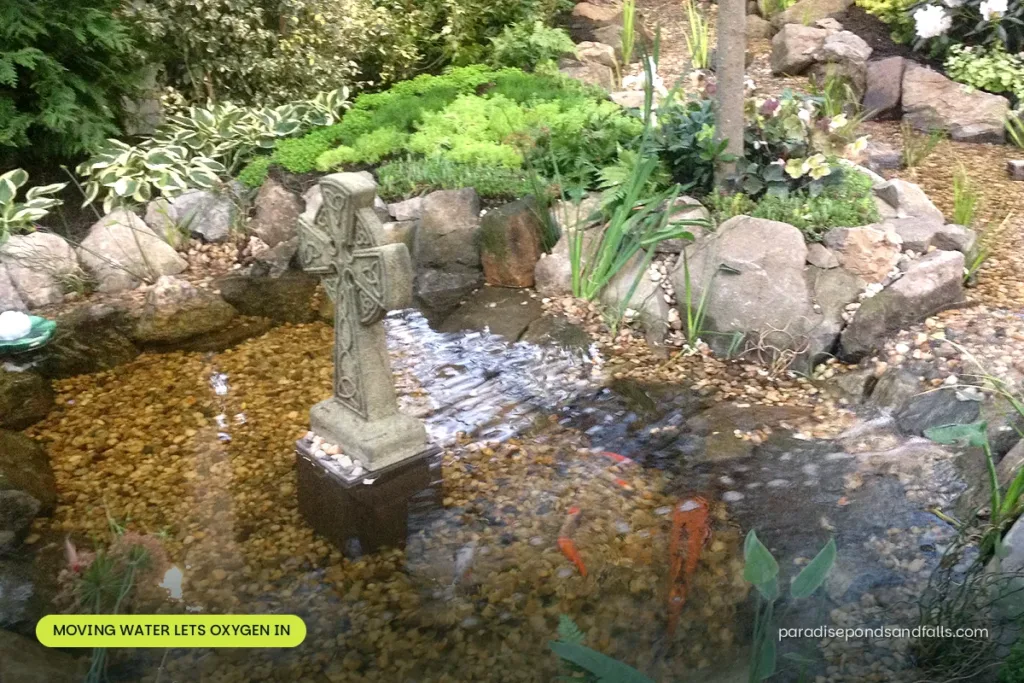 Wherever the surface moves, oxygen gets in. Still water takes it up only slowly.
Air pump, waterfall or fountain: which adds the most oxygen?
All of them add oxygen where water meets air. The difference is how much of the pond they reach and whether they can run in winter.
For most Long Island fish ponds the best setup is a waterfall for looks and filtration plus a small air pump that runs 24/7. The air pump is what carries the fish through hot nights, through the winter after the waterfall is shut down, and through the day the main pump clogs. If yours has stopped, see what to check when a pond pump is not working.
Where to put the air stone in summer and winter
In the deepest spot
Set the air stone in the deep zone, raised a few inches off the floor so it does not stir up sludge. The rising bubbles lift cool, low-oxygen bottom water to the surface and mix the whole pond. In a long or oddly shaped pond, add a second stone at the far end.
6 to 12 inches below the surface
In winter the deepest water stays near 39°F, the warmest spot in the pond, and that is where fish rest. Lift the stone onto a plant shelf so the bubbles keep a hole open in the ice without mixing that warm water with the icy surface.
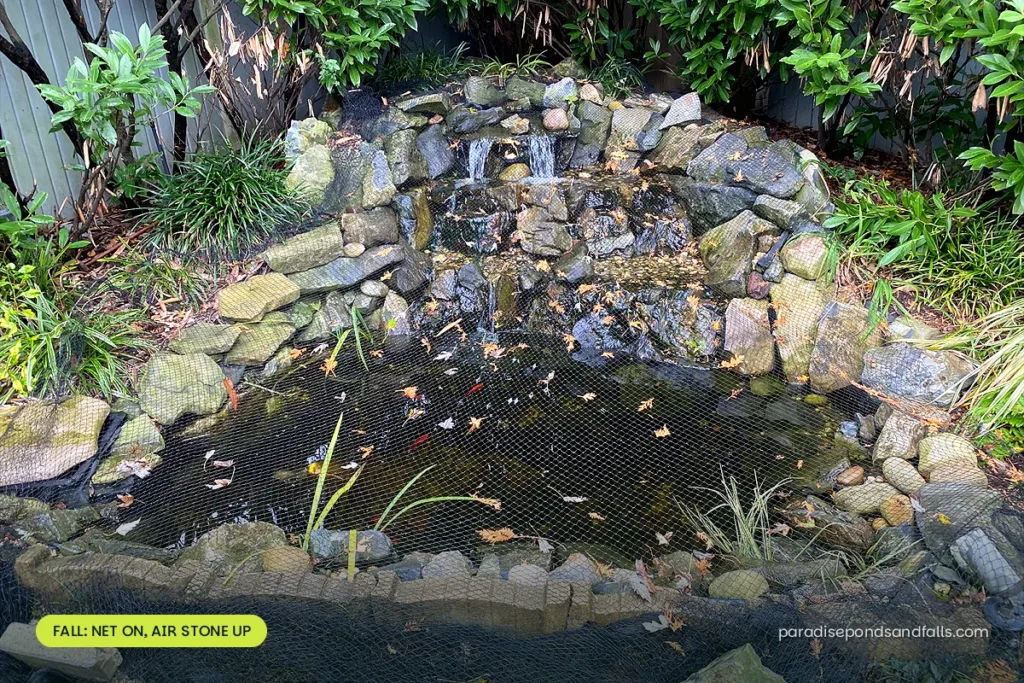 In fall the net goes on, and the air stone moves up to a shelf before the first freeze.
Keep the air pump itself dry, sheltered and above the water line, or fit a check valve in the air line so water cannot siphon back into the pump if the power goes off. Do not set it on bare ground where rain or snowmelt can pool.
What size pond aerator do you need?
Aerator kits are rated by air output (liters per minute or cubic feet per minute, CFM) and by the pond size they handle. Start with your pond's gallons, then add air for koi, heavy fish loads or a long, irregular shape. Enter your pond below for a starting point. Not sure of the size? Our koi pond size calculator also works out gallons.
- Gallons = length × width × average depth (all in feet) × 7.48 for a rectangle; multiply by about 0.8 for a round or natural shape. Use the average depth, not the deepest point.
- Air stones: about one for every 1,000 to 2,000 gallons, and at least one in every separate deep zone.
- Depth rating: check the maximum depth on the box. It must be deeper than your deepest zone, or the pump cannot push air out of the stone.
- Between two sizes? Go up. A slightly bigger pump costs little more to run, and most kits have a valve to turn the air down.
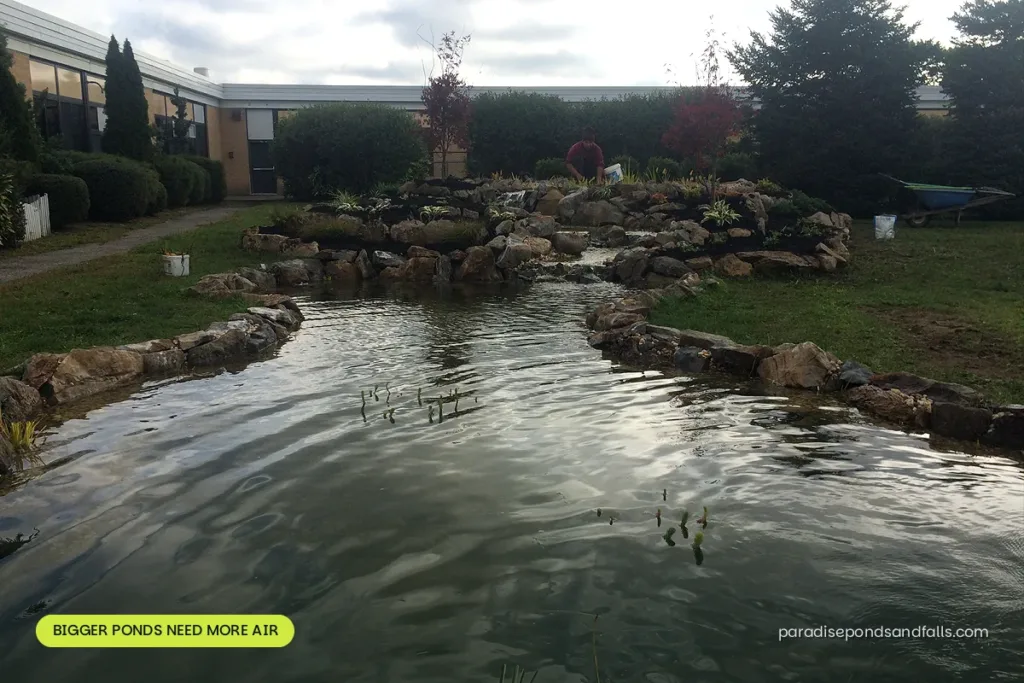 A large or long pond needs more than one stone, spread out so no corner sits still.
Running an aerator through a Long Island winter
Once the waterfall is off and ice starts to form, the aerator becomes the pond's lifeline. Four habits keep it working until spring.
Move the stone up before the first freeze
Do it when the water drops below 50°F, usually in November here. Set it on a shelf 6 to 12 inches down.
Run it 24 hours a day
The hole it keeps open lets carbon dioxide and gases from rotting leaves escape and lets fresh oxygen in. Switching it off on the coldest nights is exactly when ponds freeze over.
Back it up with a de-icer in hard freezes
In a long cold snap, bubbles alone may not hold the hole open. A floating de-icer with a thermostat keeps it clear. Our guide on how to winterize a koi pond covers the full setup.
Check it after every freeze and snowstorm
Make sure air is still bubbling and the hole is open. If the pond freezes over, never smash the ice: the shock stresses fish. Melt a hole with a pot of hot water, then fix the aerator.
Aerator care: three jobs a year
An air pump is one of the most reliable parts of a pond, as long as it gets these three checks.
Spring: clean or replace the air stone. Stones clog with algae and mineral scale, and a clogged stone puts out far less air. Whenever the bubbles weaken: check the line for kinks, then replace the pump's diaphragms. They wear out after a few years of nonstop running, and a rebuild kit costs far less than a new pump. Fall: raise the stone, test the check valve and make sure the pump sits dry and protected for winter. Our pond maintenance visits include these checks.Paradise Ponds & Falls adds air pumps, diffusers and de-icers to existing ponds across Nassau and Suffolk County, sized to your pond and your fish. We can set it up on a maintenance visit or as part of our fall and winter pond prep.
Keep reading: how an ecosystem pond keeps water clear, the best fish for an outdoor pond, and how to fix green pond water.
Pond aerator FAQs
Do I need an aerator if my pond has a waterfall?
Not always. A waterfall that runs 24/7 adds plenty of oxygen to a lightly stocked pond. But it mostly mixes the top of the pond, it is often shut off for winter on Long Island, and fish suffer if the pump fails. Koi ponds and deep ponds are safer with an air pump as well.
Should a pond aerator run all the time?
Yes. Oxygen is lowest at night and before dawn, so an aerator should run 24 hours a day, all year. Backyard air pumps use little power, often less than a light bulb.
Where should the air stone go in winter?
On a shelf about 6 to 12 inches below the surface, not on the bottom. That keeps a hole open in the ice without mixing the warmer bottom water, where fish rest, with icy surface water.
Is a de-icer the same as an aerator?
No. A de-icer is a small heater that keeps a hole open in the ice so gases can escape, but it adds no oxygen. An aerator moves water and adds oxygen. Many Long Island ponds use both in winter.
How much does it cost to run a pond aerator?
Most backyard air pumps use about 5 to 35 watts. At around 25 cents per kWh, that is roughly $1 to $6 a month running nonstop.
How can I add oxygen to a pond quickly?
Spray a hose across the surface, point a pump outlet at the surface or run a battery air pump. Stop feeding, and if you change some water, treat tap water with a dechlorinator. Then fix the cause, such as a failed pump, heavy sludge or too many fish.