

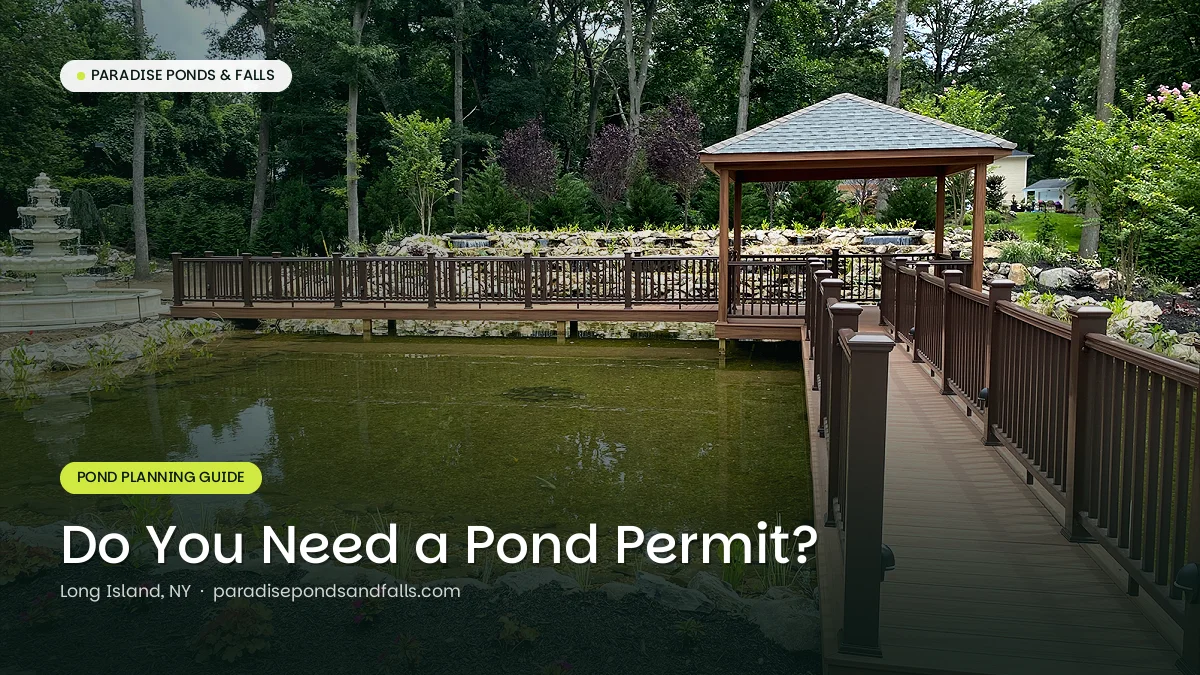
"Do I need a permit?" is one of the first questions we hear when someone plans a pond. On Long Island the honest answer is: it depends on where you live, how deep the pond is and what is around it. Rules come from your town or village, New York State and sometimes your homeowners' association. This guide shows the five things to check before anyone starts digging.
A small, shallow decorative pond on Long Island often does not need a building permit, but you still need to check. Ask your town or village building department about ponds deeper than 24 inches, fencing and setbacks; call 811 at least two working days before digging; check for DEC wetland rules if you live near a bay, creek or wetland; use a licensed electrician for any new outdoor circuit; and read your HOA rules.
Do you need a permit for a backyard pond?
For many small garden ponds and pondless waterfalls, no building permit is needed. Permits are more likely when the pond is deep, when it sits close to a property line, a wetland or the shore, when it involves new electrical work, or when it replaces a swimming pool. The safest approach is a five-minute call to your building department before the design is final.
5 things to check before you dig
We go through this same list on every pond we plan in Nassau and Suffolk County.
Your town or village building rules
Ask how your town or village treats a decorative pond: whether there is a depth that triggers a permit or a fence, how far it must be from property lines, and whether it counts as an accessory structure. Some Long Island municipalities apply pool-style fencing rules to water deeper than 24 inches, others do not. Get the answer for your address, not your neighbor's.
Call 811 before any digging
New York law requires anyone digging, homeowners included, to request utility markings first. On Long Island the request goes to New York 811: dial 811 at least 48 hours, and no more than 10 working days, before you dig. The service is free, and you wait until every utility has marked or cleared its lines.
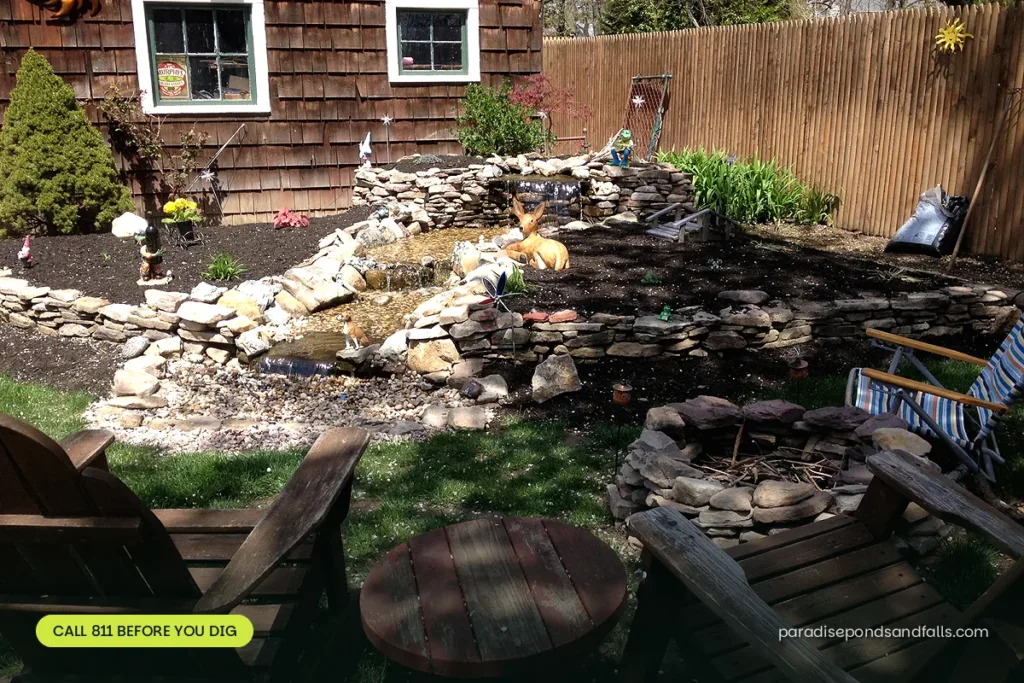 Every pond and waterfall we build starts with an 811 request and marked lines.
Wetlands and the shoreline
Much of Long Island sits near tidal or freshwater wetlands. The New York State DEC regulates work in tidal wetlands and in an adjacent area that can reach up to 300 feet inland, and in freshwater wetlands plus a 100-foot adjacent area in most cases. If your yard is near a bay, harbor, creek or marsh, check the DEC Environmental Resource Mapper and ask DEC before digging.
Electrical work for the pump and lights
Pumps, UV clarifiers and lights need power, and anything near water must run on a GFCI-protected outlet. If you need a new outdoor outlet or circuit, hire a licensed electrician; new electrical work usually needs a permit and an inspection. Plugging into an existing GFCI outdoor outlet usually does not.
HOA rules, deeds and neighbors
Homeowners' associations and deed restrictions can limit ponds, fences or rock work even where the town does not. Also think about drainage: a pond should not overflow toward a neighbor's yard, and heavy rain needs somewhere to go.
Pond depth, fences and the 24-inch question
The 24-inch number comes from swimming pool rules. New York's building code requires a barrier around residential swimming pools that hold more than 24 inches of water, and a pool is defined by its use for swimming, bathing or wading. A decorative pond is not built for swimming, but some towns and villages write their own rules for deep ponds or water features, so the depth of your pond matters when you call.
That matters most for koi ponds, which need a deep zone of at least 3 feet on Long Island. See how deep a koi pond should be. If your town requires a fence for deep water, you have options:
- Fence the yard or the pond area to the required height.
- Keep the deep zone small and surround it with wide, shallow planting shelves.
- Choose a pondless waterfall, which has no open water at all. See our pondless waterfall service.
Quick guide: what usually needs a check
Use this as a starting point for the call to your building department.
Converting a swimming pool to a pond
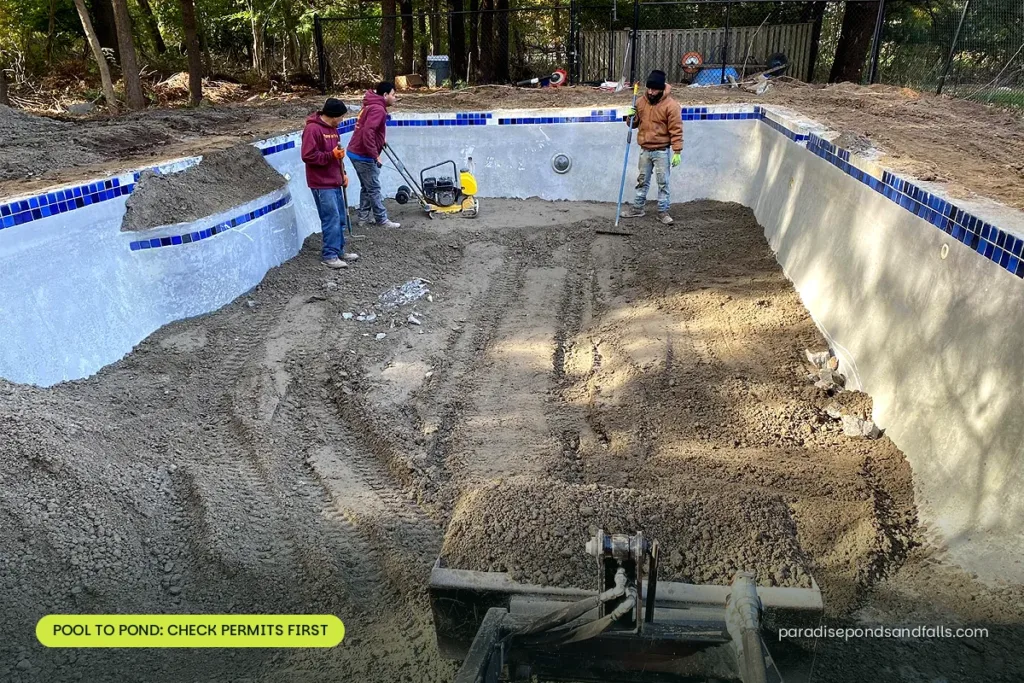 A pool to pond conversion reuses the pool shell, so pool rules may still apply.
Turning an old pool into a pond is a popular project on Long Island, but it raises its own permit questions. The town may treat it as a pool alteration or removal, the water may still be deeper than 24 inches, and the existing fence may need to stay. Ask about all three before you drain the pool. Our pool to pond conversion team plans the conversion around your town's rules.
Questions to ask your building department
Have these ready when you call, along with your address and a rough sketch:
Does a decorative pond need a permit, and is there a depth that triggers one? Does water deeper than 24 inches need a fence or barrier, and how high? How far must a pond be from property lines, the house and septic or cesspool systems? Does a new outdoor outlet for the pump need an electrical permit and inspection? Is the property in a wetland, coastal or historic area with extra review?Paradise Ponds & Falls has designed and built ponds across Nassau and Suffolk County for over 20 years. We plan depth, setbacks and power with your town's rules in mind, request the 811 markings and keep your project on the right side of the code.
Still deciding what to build? Compare small backyard pond ideas, learn how an ecosystem pond works, or see our pond and waterfall installation service.
Pond permit FAQs
Do I need a permit for a small backyard pond on Long Island?
Often not for a small, shallow decorative pond, but it depends on your town or village. Call your building department with the size and depth before you start, and always call 811 before digging.
Does a pond need a fence on Long Island?
Some municipalities require a fence or barrier around water deeper than 24 inches, borrowing from swimming pool rules; others do not apply that to decorative ponds. Ask your building department, and supervise young children around any open water.
Is a koi pond considered a swimming pool in New York?
Not usually. The state's pool barrier rules are written for pools used for swimming, bathing or wading. But because koi ponds are often deeper than 24 inches, some towns and villages apply their own rules to them, so check locally.
Do I need to call 811 to dig a small pond?
Yes. New York requires a utility locate request before any digging, including small homeowner projects. Call 811 at least 48 hours, and no more than 10 working days, before you dig.
Can I build a pond near a wetland or the water?
Possibly, but it may need DEC approval. Work in tidal wetlands and an adjacent area of up to 300 feet, or freshwater wetlands and usually a 100-foot adjacent area, is regulated. Check the DEC mapper and contact DEC first.
Do I need an electrician for a pond pump?
Not if you plug into an existing GFCI-protected outdoor outlet. If you need a new outlet or circuit, use a licensed electrician; new electrical work usually needs a permit and an inspection.