

Every clear pond runs on bacteria you cannot see. They live on the rocks, gravel and filter media, breaking down fish waste and dead leaves before those turn into green water and sludge. Bottled bacteria can give them a head start, but only if you add the right kind at the right time. Here is how beneficial bacteria for ponds actually work, and where barley straw fits in.
Beneficial bacteria turn toxic ammonia from fish waste into much safer nitrate and break down sludge on the bottom. Add them weekly once the water stays above about 50°F, use a cold-water formula below that, and give an extra dose after a clean-out, a big water change, new fish or a medication. Barley straw is a slow, gentle algae preventer, not a cure: it works best placed early in spring.
What beneficial bacteria do in a pond
Nitrifying bacteria
Live on filter media, rocks and gravel. They turn ammonia from fish waste into nitrite, then into nitrate, which plants take up as food.
Sludge-eating bacteria
Break down dead leaves, uneaten food and muck on the bottom, so less of it turns into nutrients for algae.
A healthy pond already has both kinds. Bottled bacteria help when the natural population is low: in a new pond, in cold water, after a clean-out or when the pond is overloaded. They work best alongside a good biological filter and plenty of oxygen; see our pond aerator guide.
When to add bacteria: a guide by water temperature
Pick your water temperature and anything that has happened lately.
Times your pond needs an extra dose
Bacteria numbers drop after anything that removes or disturbs them. Add an extra dose:
After a full clean-out or a spring start-up After a water change of more than about 20 percent When the pond is new, or when you add several fish at once After a medication or algae treatment, once its label says it is safe After rinsing the filter media hard, or replacing it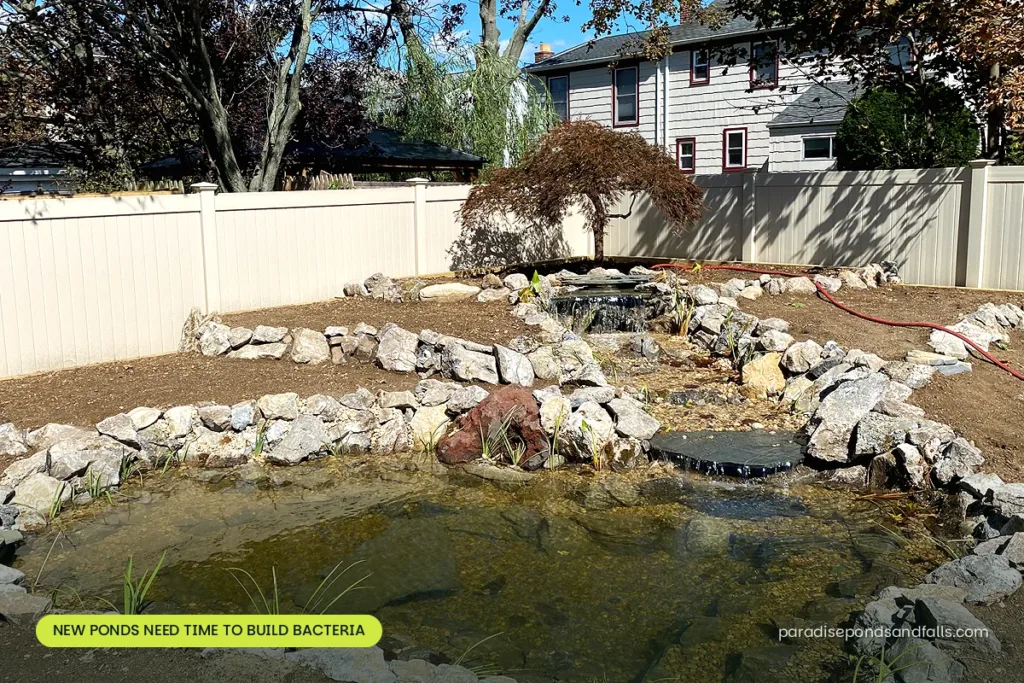 A brand-new pond has very few bacteria. Regular doses for the first weeks help it settle.
Barley straw: what it can and cannot do
As barley straw slowly decays in well-oxygenated water, it releases compounds that are thought to slow the growth of new algae. Here is the honest picture:
✓ It can
Help prevent algae when placed early, before the spring bloom Work gently, with no risk to fish or plants Support a pond that is already mostly in balance✗ It cannot
Clear a pond that is already green; it takes weeks to start working Make up for poor filtration, too many fish or overfeeding Work well in still water or very cold waterHow to use barley straw
Use the right amount
Rutgers Cooperative Extension suggests about 1 pound of straw per 2,000 gallons for small ponds (fact sheet FS1171). Product labels vary, so follow yours.
Put it where water moves
In a mesh bag near the waterfall, in the stream or in the skimmer area, where it gets plenty of oxygen.
Start early
Add it in early spring as the water warms, weeks before algae usually appears.
Replace it mid-season
Straw added in spring is usually spent by midsummer. Pull out the old bag before it sinks and rots.
Bacteria cannot fix a pond that is undersized, overstocked or poorly filtered. Paradise Ponds & Falls finds the real cause and fixes it, across Nassau and Suffolk County.
Related: how to fix green pond water, how an ecosystem pond keeps itself balanced, and our koi pond maintenance schedule.
Pond bacteria and barley straw FAQs
How often should I add beneficial bacteria to my pond?
Weekly from spring to fall once the water stays above about 50°F, following the product label, plus extra doses after clean-outs, big water changes or new fish.
Can you add too much beneficial bacteria?
It is very hard to harm fish with bacteria products, but overdosing wastes money. Any excess simply dies off without food to eat. Stick to the label dose.
Does beneficial bacteria work in cold water?
Standard bacteria slow right down below about 50°F. Cold-water formulas are made to keep breaking down sludge in cooler water, which is why they are used in early spring and late fall.
How long does barley straw take to work?
Usually several weeks, because the straw has to start breaking down first. That is why it works best as prevention in spring, not as a fix for water that is already green.
Is barley straw safe for koi?
Yes, when used at the recommended rate. Remove old straw before it rots on the bottom, because rotting straw uses up oxygen.