

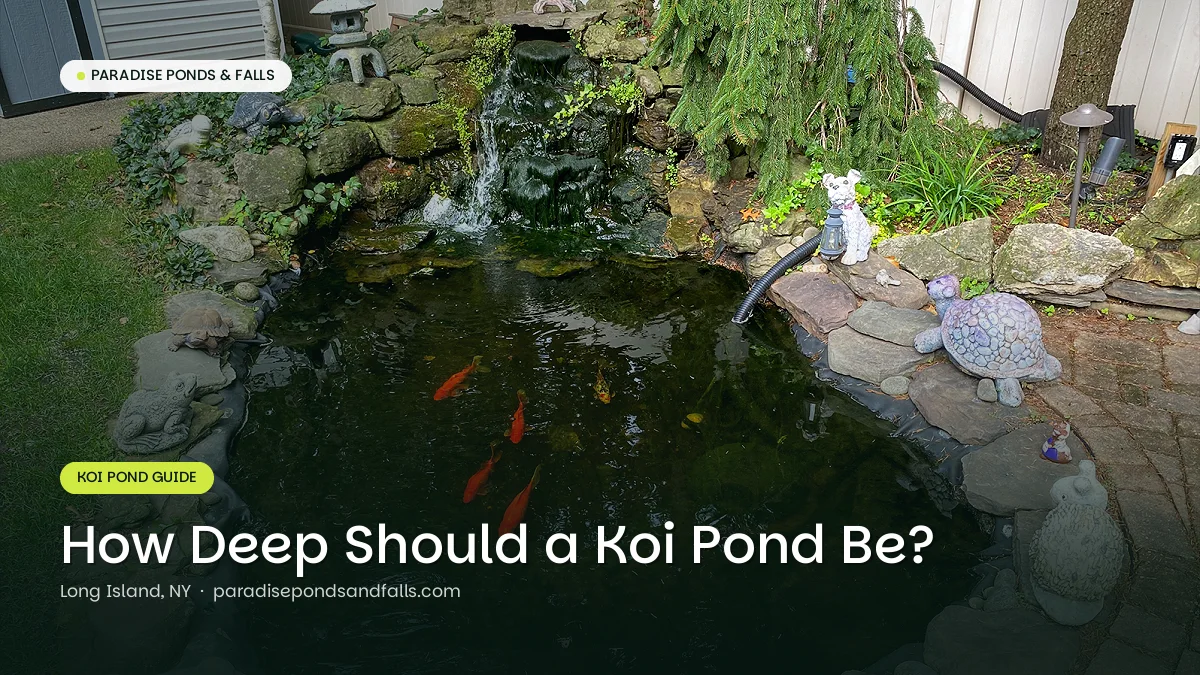
How deep should a koi pond be? At least 3 feet in its deepest area, and 3½ to 4 feet is better for koi on Long Island and anywhere in New York. That depth gives koi a stable place to rest through winter ice and summer heat, keeps herons from wading in, and leaves room for fish that can grow two to three feet long.
These are the deepest-zone numbers. Most of the pond can be shallower, with planting shelves around the edges.
Koi pond depth requirements by pond type
How deep you dig depends on what will live in the pond. Use this as a starting point for Long Island's climate.
Why koi pond depth matters
A safe zone under the ice
Water is heaviest at about 39°F, so the deepest part of the pond stays near that temperature while the surface freezes. Ice on Long Island ponds is usually only a few inches thick, so 3 feet leaves koi plenty of stable water.
Cooler water in a heat wave
Shallow ponds heat up fast, and warm water holds less oxygen and turns into green pond water sooner. A deep zone stays cooler and gives koi somewhere to rest on hot July afternoons.
Nowhere for herons to stand
Great blue herons hunt by wading in shallow water. Steep sides that drop into deep water give them no footing and give your koi a place to escape. More in our guide on how to protect koi from herons.
Room for big fish
Koi can grow two to three feet long and live for decades. They need depth and swimming space to stay healthy and reach full size. For layouts that give them that room, see our koi pond ideas from real Long Island projects.
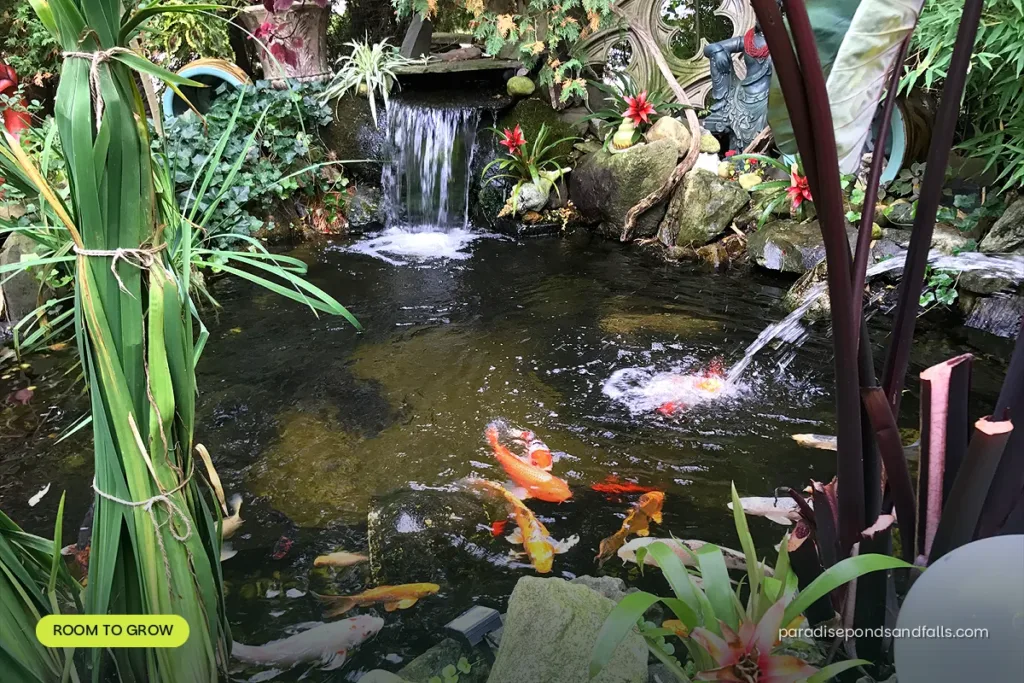 Koi grow large and need deep water and room to swim.
Is 3 feet deep enough for a koi pond?
Yes, 3 feet is the minimum that works for koi in New York winters, as long as the pond also has good filtration, aeration and enough gallons. If you are building new, going to 3½ or 4 feet costs little extra and gives your fish a more stable home.
Is 2 feet deep enough for koi?
Not for keeping koi year-round on Long Island. At 2 feet there is very little stable water under the ice, the pond overheats in summer and herons can wade in easily. A 2-foot pond is a good depth for goldfish or a water garden instead.
Can a koi pond be too deep?
It can be more pond than you need. Past about 6 feet it gets hard to see your fish, clean the bottom and keep water moving, so very deep ponds need bottom drains and stronger pumps. Deeper water also raises safety and permit questions, covered below.
Koi pond size calculator
Depth is only half the story. Koi need enough total water too. Enter your pond's size to estimate its gallons and how many adult koi it can support.
This is an estimate. Rocks, gravel and shelves take up space, and stocking depends on filtration too. With our koi pond installation, we size every pond to the number of fish you want to keep.
How many koi can live in a 500-gallon pond?
A 500-gallon pond is too small for koi long term. Koi grow quickly, and a pond that size cannot dilute their waste or give them room to swim. It makes a lovely home for a few goldfish instead; see the best fish for an outdoor pond. For koi, plan on at least 1,000 gallons, plus about 250 gallons for every adult fish. If you mainly want the sound of moving water in a small space, look at the pondless and small-yard designs in our backyard waterfall ideas.
Plant shelves, sides and safety
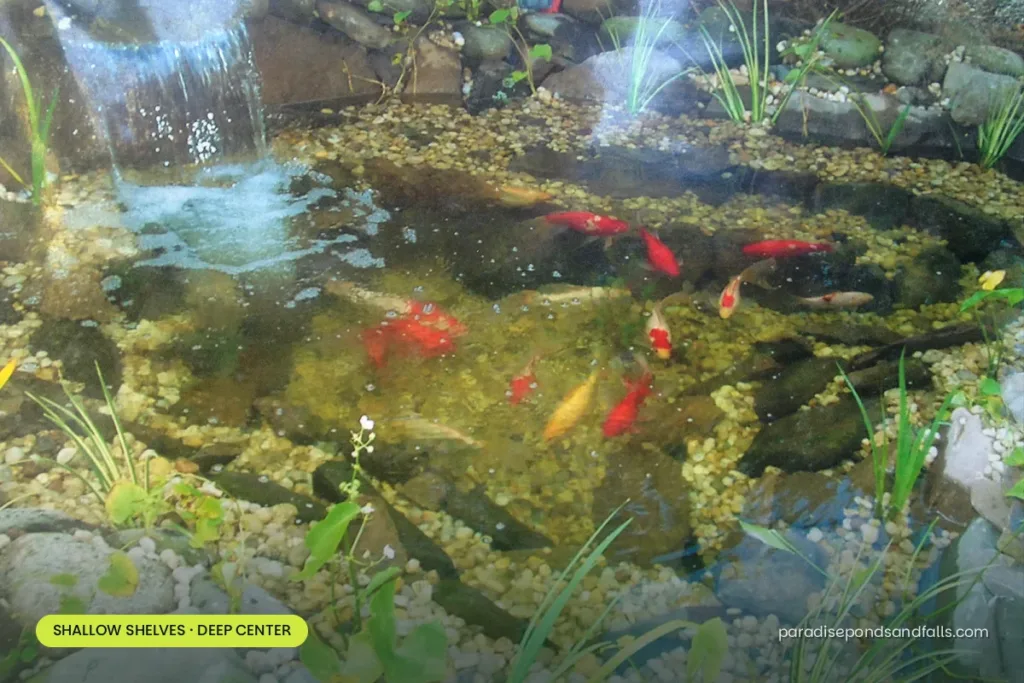 Shallow shelves around the edge, with the deep zone in the middle.
A well-designed koi pond is not one deep hole. It steps down from the edge:
- Plant shelves at 8–12 inches hold marginal plants that filter the water and soften the edges.
- A steeper drop into the deep zone keeps herons out of the area where your koi rest.
- Shelves double as a safe step-out if someone slips in, which matters with children and pets around.
- Check local rules before you dig. Some Long Island towns and villages treat water deeper than 24 inches like a swimming pool for fencing and permits. Rules vary (see our guide to pond permits on Long Island), so check with your town's building department. We help our clients with this during design.
Depth planning checklist
✓ Deepest zone of at least 3 ft, ideally 3½–4 ft ✓ At least 1,000 gallons, plus about 250 gallons per adult koi ✓ Planting shelves at 8–12 in around the edge ✓ Steep sides into the deep zone to stop herons ✓ Pump and filter sized for the full volume ✓ Aeration and a de-icer plan for winter ✓ Town rules checked for water deeper than 24 inOnce your pond is built, the deep zone is what gets your fish through the cold. See our guide on how to winterize a koi pond for the rest of the winter plan, or let our fall and winter pond prep crew handle it for you.
We design and build koi ponds with the right depth, shelves, filtration and winter protection for our climate, across Nassau and Suffolk County.
How deep should a koi pond be? FAQs
How deep should a koi pond be?
At least 3 feet in the deepest area, and ideally 3½ to 4 feet for koi in New York. Large koi collections do well at 4 to 6 feet with a bottom drain and strong circulation.
Is 18 inches deep enough for a koi pond?
No. 18 inches is a good depth for a water garden or a few goldfish, but it is far too shallow for koi to survive Long Island winters and summer heat.
How deep does a pond need to be for koi to survive the winter?
On Long Island, at least 3 feet in one area. The deep zone stays near 39°F under the ice, as long as you also keep a hole open in the ice for gas exchange.
Can a koi pond be too deep?
Ponds deeper than about 6 feet are harder to clean, keep circulating and enjoy, because you cannot see the fish on the bottom. They usually need bottom drains and stronger pumps.
How many koi can I keep per gallon?
A common rule of thumb is a pond of at least 1,000 gallons with about 250 gallons per adult koi. Good filtration lets you keep more; poor filtration means fewer.
Do I need a fence or permit for a deep koi pond?
It depends on your town. Some Long Island towns and villages apply pool-style rules to water deeper than 24 inches. Check with your local building department before you build.