

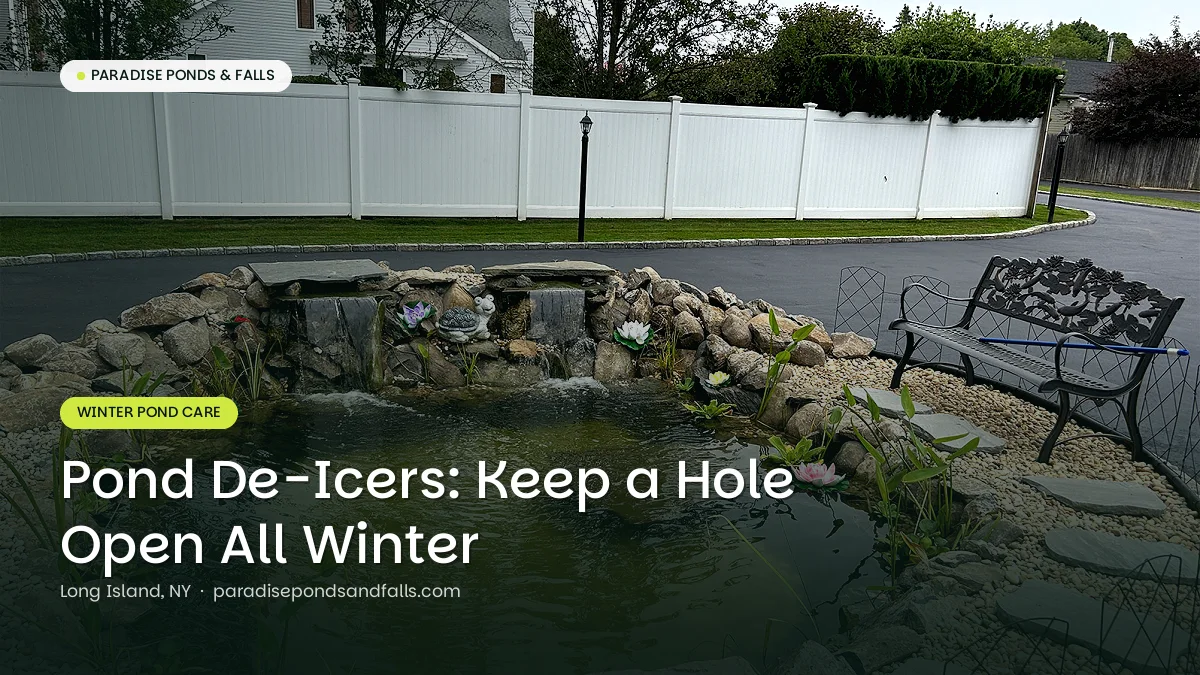
When a Long Island pond freezes over, the ice traps gases from rotting leaves and fish waste underneath it. A pond de-icer keeps a small hole open so those gases can escape. It is one of the cheapest pieces of insurance a fish pond can have, as long as you pick the right wattage and set it up safely.
A pond de-icer is a small floating or sinking heater with a thermostat. It switches on near 35°F and keeps a hole open in the ice, but it does not warm the pond. For most Long Island backyard ponds, a 100 to 300 watt de-icer paired with an aerator is enough; ponds without aeration, or in open, windy spots, may need a 750 to 1,500 watt unit. Plug it into a GFCI outlet and set it up before the first hard freeze.
How a pond de-icer works
Inside is a heating element and a thermostat. When the surface water nears freezing, the de-icer switches on and warms a small patch around itself; when the water warms up, it shuts off. Most units switch on around 35°F and off somewhere between 45 and 50°F, so in a mild week it hardly runs at all. There are three kinds you will see:
Floating de-icer
Sits on the surface and holds a hole open around itself. Easy to place, and you can see at a glance that it is working.
Sinking de-icer
Rests on a shelf just under the surface and melts a hole from below. Some models convert between floating and sinking.
Pond heater
Warms the whole pond rather than one spot. It is costly to run, and Long Island ponds with a 3-foot deep zone do not need it.
What wattage does a Long Island pond need?
Wattage depends on pond size, how exposed the pond is to wind and whether an aerator is also running. Long Island winters are milder than upstate (USDA zones 7a and 7b), but a week of single-digit nights and wind still freezes ponds over. As a starting point:
- Small ponds and water gardens (under about 1,000 gallons) with an aerator: 100 to 300 watts.
- Medium ponds (1,000 to 5,000 gallons) with an aerator: about 300 watts, or two small units at opposite ends.
- Ponds with no aeration, or in open, windy spots: 750 to 1,500 watts.
- Check the maker's chart. Gallon ratings vary a lot between brands, so match the box to your pond size and climate zone.
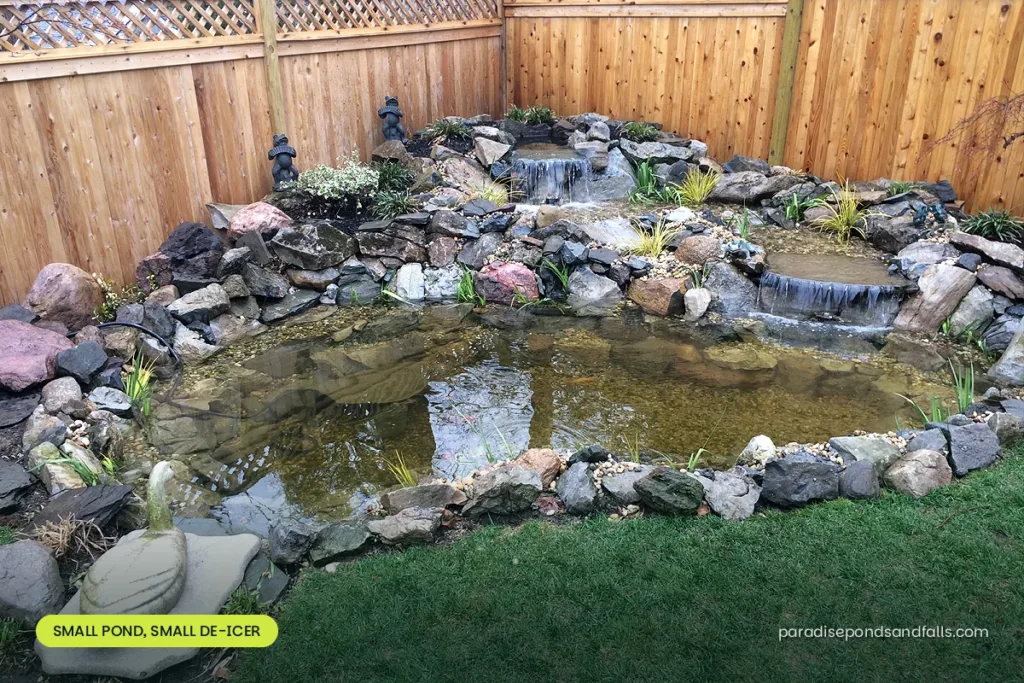 A small, sheltered backyard pond with an aerator rarely needs more than a low-wattage de-icer.
What does a pond de-icer cost to run?
Running cost depends on the wattage and how many hours a day the thermostat keeps it on. Try your own numbers:
Two ways to keep the bill down: run an aerator alongside it, since moving water is slower to freeze, and choose the lowest wattage that holds a hole open in your pond. A model with a thermostat costs far less than one that runs nonstop.
De-icer vs aerator: do you need both?
They are often sold side by side, but they do different jobs.
On Long Island the best winter setup for a fish pond is both: the aerator runs all winter and keeps oxygen up, and the de-icer backs it up in the hardest freezes. For a lightly stocked pond, a well-placed aerator alone gets through most of our winters. See our pond aerator guide for sizing and placement.
Setting up a de-icer safely
Electricity, water and ice call for care. Five steps cover it.
Use a GFCI-protected outdoor outlet
Anything in or near a pond must run on a GFCI outlet. If you need a new outlet, hire a licensed electrician; see our guide to pond permits for what that involves.
Skip the indoor extension cord
Plug straight into the outlet or use a heavy, outdoor-rated cord, and keep the connection off the ground and out of snow and puddles.
Keep it away from the skimmer
If the pump stays on, the current drags a floating de-icer into the skimmer opening. Place it in a calm spot near the deep zone and secure the cord at the edge so it stays put.
Plug it in before the first hard freeze
Late November is usually right on Long Island. Watch it for a day to make sure it switches on and holds a hole.
Check it after every freeze and storm
Make sure the hole is open and the GFCI has not tripped. In spring, once the ice season is over, take it out, dry it and check the cord for cracks before storing it.
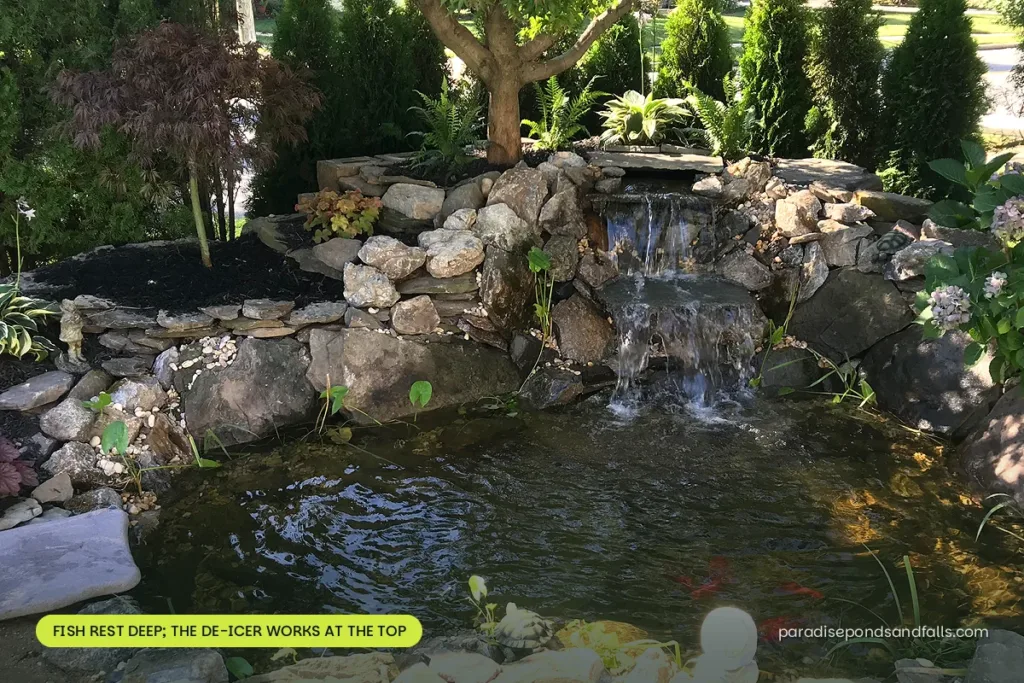 Koi spend the winter resting in the deep zone. The de-icer only has to keep a hole open at the top.
Common de-icer problems and fixes
The hole keeps closing: the unit is too small, the GFCI has tripped or the thermostat has failed. Check the power first, then add an aerator or step up the wattage. It seems to run all the time: wind across an open pond keeps cooling it. A windbreak, a lower-wattage unit plus an aerator, or a better-sheltered spot all help. It froze in place after a power cut: let it thaw out once power is back. Do not chip it free; you can cut the cord or crack the housing. Snow has covered the hole: brush it off gently. Snow on ice also blocks light, so keep the area around the hole clear. ⚠️ Never break pond ice with a hammer or shovel. The shock waves stress fish resting below. If the pond freezes over, melt a hole with a pot of hot water, then fix the de-icer.Our fall and winter prep service installs and tests de-icers and aerators, cleans skimmers and filters and nets ponds across Nassau and Suffolk County.
More winter reading: how to winterize a koi pond, our fall and winter prep service, and pond maintenance plans for next season.
Pond de-icer FAQs
Do I need a de-icer for my pond?
If you keep fish and your pond freezes over, you need a de-icer or an aerator that keeps a hole open. The hole lets gases from rotting leaves and fish waste escape. A pond with no fish does not need one.
What wattage pond de-icer do I need?
For most Long Island backyard ponds with an aerator, 100 to 300 watts is enough. Larger ponds, ponds without aeration and windy, open sites may need 750 to 1,500 watts. Check the maker's chart for your pond size.
Does a pond de-icer heat the whole pond?
No. It only keeps a small area of the surface free of ice. The bottom of a pond stays near 39°F on its own, and that is where fish rest. A heater that warms the whole pond is rarely needed on Long Island.
Is a de-icer or an aerator better?
They do different jobs. An aerator adds oxygen and keeps a hole open in most weather; a de-icer keeps a hole open in hard freezes but adds no oxygen. Many Long Island fish ponds use both.
How much does it cost to run a pond de-icer?
A 300-watt de-icer running 12 hours a day costs about $27 a month at 25 cents per kWh; a 1,500-watt unit running the same hours costs about $135. Thermostat models only run when needed, so mild weeks cost far less.
When should I put a de-icer in my pond?
Before the first hard freeze, usually by late November on Long Island. Take it out in spring once the ice season is over, around March.