

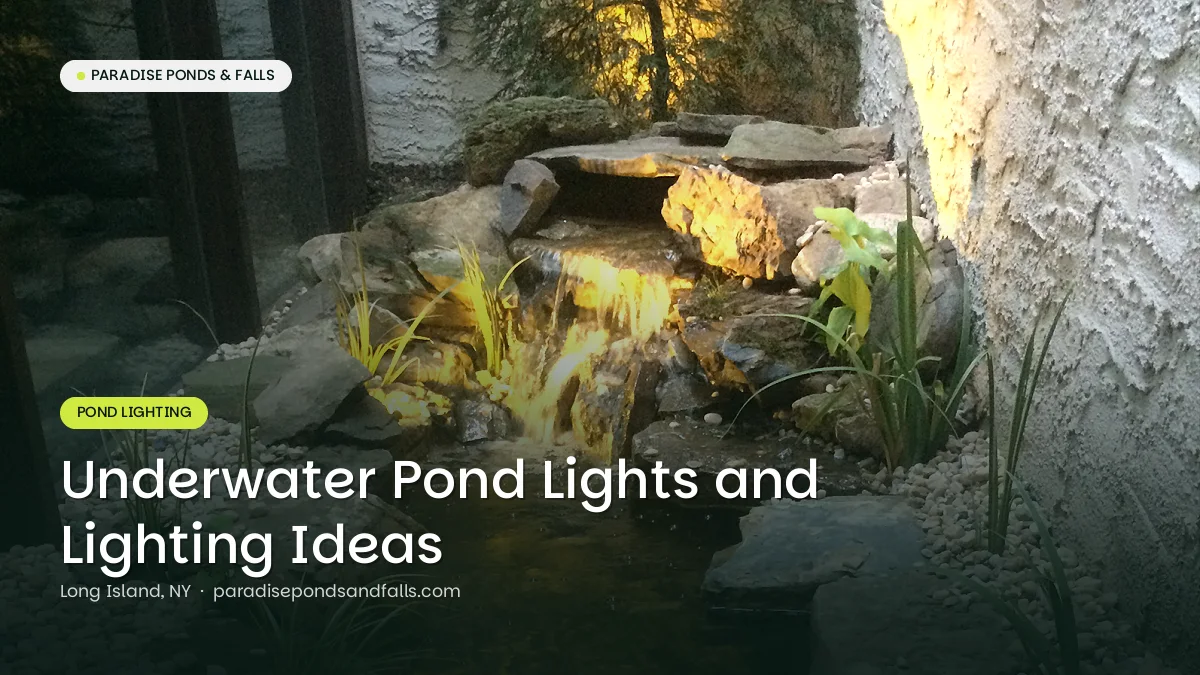
Most people see their pond after work, when the light is going. A few well-placed lights turn the pond and waterfall into the best view from the house on a summer night. The trick is to light the water, not the fixtures, and to keep it subtle. Here are the pond lighting ideas that work, the types of lights to use and how to wire them safely.
Underwater pond lights are sealed, low-voltage LED fixtures that sit in the pond or waterfall. The most effective setup is a warm white light uplighting the waterfall from below, a soft glow in the deep zone and a few landscape spots on nearby plants or rocks, all aimed away from where you sit. Run them on a 12-volt transformer plugged into a GFCI outlet, with a timer or photocell.
6 pond lighting ideas
Pick two or three, not all six. Less light looks more natural.
Uplight the waterfall
A light under the spill stone, facing up into the falling water, makes the whole waterfall glow. It is the single most effective pond light.
Glow the deep zone
A submersible light on the bottom of the deep zone, aimed across the pond, shows off the fish at night.
Spotlight one plant or stone
A Japanese maple, an ornamental grass or a large boulder at the edge, lit from below, gives the eye a focal point.
Light the stream
Small lights tucked into the stream at each drop catch the moving water from the falls to the pond.
Mark the path and edges
Low path lights along the walkway and stepping stones keep people safe near the water.
Moonlight from a tree
A light high in a tree pointing down casts soft, natural-looking light over the pond and the rocks.
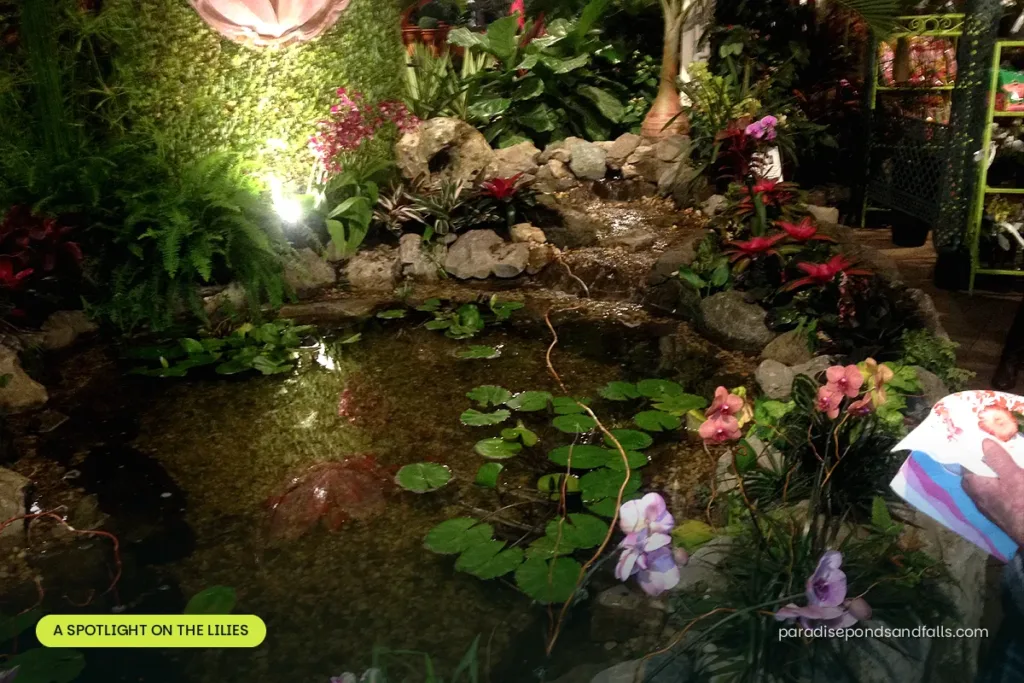 One light on a planted corner is often enough to bring a pond to life at night.
Types of pond lights compared
LEDs have replaced older halogen pond lights almost everywhere: they use a fraction of the power, run cool and last for years.
Where to aim pond lights
Five rules keep pond lighting natural instead of glaring:
Aim away from the viewer. Lights should point from your seat toward the water, never back at the patio. Hide the fixture. Tuck lights behind rocks or under ledges so you see the glow, not the lamp. Choose warm white. Around 2,700 to 3,000 Kelvin looks like natural evening light; cool white can look harsh. Light the moving water. Falls and ripples sparkle; still water just looks dark. Leave some darkness. Contrast is what makes the lit areas stand out.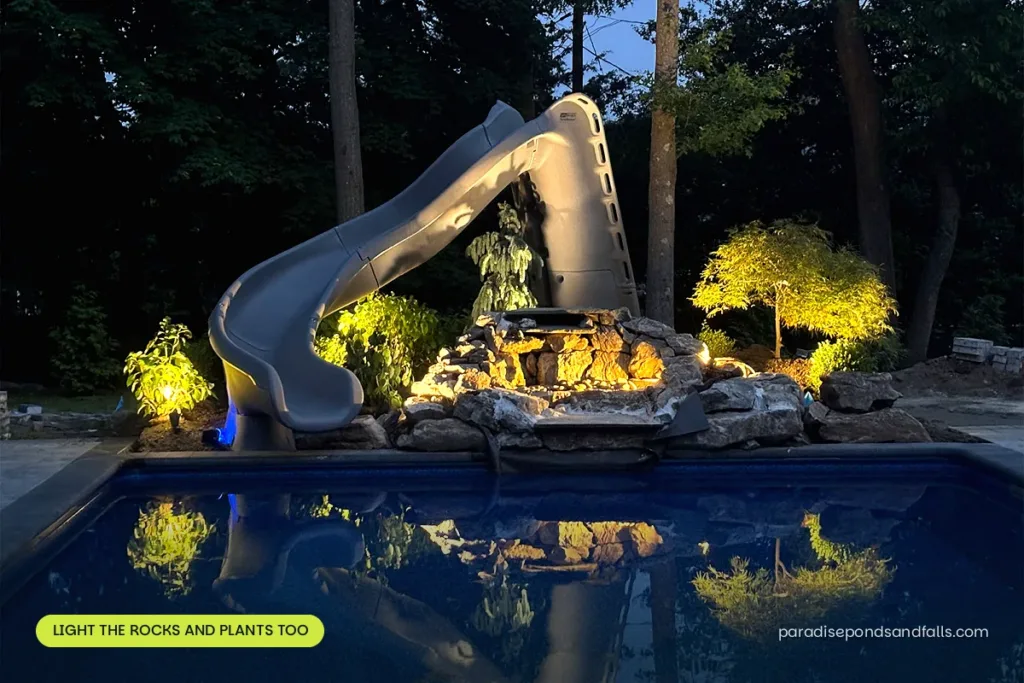 Lighting the rocks and plants around a water feature matters as much as lighting the water.
How many pond lights do you need?
A quick estimate for a typical LED setup. We design the exact layout on site.
Wiring pond lights safely
- Use low voltage. Most pond lights run on 12 volts from a transformer, which is far safer near water.
- Plug into a GFCI outlet. Every pond light, pump and transformer should be GFCI-protected.
- Bury outdoor-rated cable and keep connections above the water line, in a dry spot.
- Use a licensed electrician for new outlets. See our guide to pond permits for when that needs a permit.
- Add a timer or photocell so the lights come on at dusk and go off at bedtime.
Paradise Ponds & Falls adds underwater and landscape lighting to new and existing ponds and waterfalls across Nassau and Suffolk County.
More ideas: backyard waterfall ideas, koi pond ideas and small backyard pond ideas.
Pond lighting FAQs
Are underwater pond lights safe for fish?
Yes. Sealed LED pond lights run cool and on low voltage. Give fish dark places to rest and switch lights off for the night with a timer rather than leaving them on until morning.
What color light is best for a pond?
Warm white, around 2,700 to 3,000 Kelvin, looks most natural. Colored lights are fun for parties, but most homeowners prefer warm white every day.
Are solar pond lights any good?
They are easy to add but usually dim and short-lived, especially in a shaded yard or in winter. Wired low-voltage LEDs are brighter and far more reliable.
How much does it cost to run pond lights?
Very little. A typical LED pond lighting setup uses under 50 watts in total, which at around 25 cents per kWh is roughly $2 a month for six hours a night.
Can lights be added to an existing pond?
Yes. Submersible lights and landscape spots can be added to most ponds and waterfalls, with the cable run hidden under rocks and gravel.