

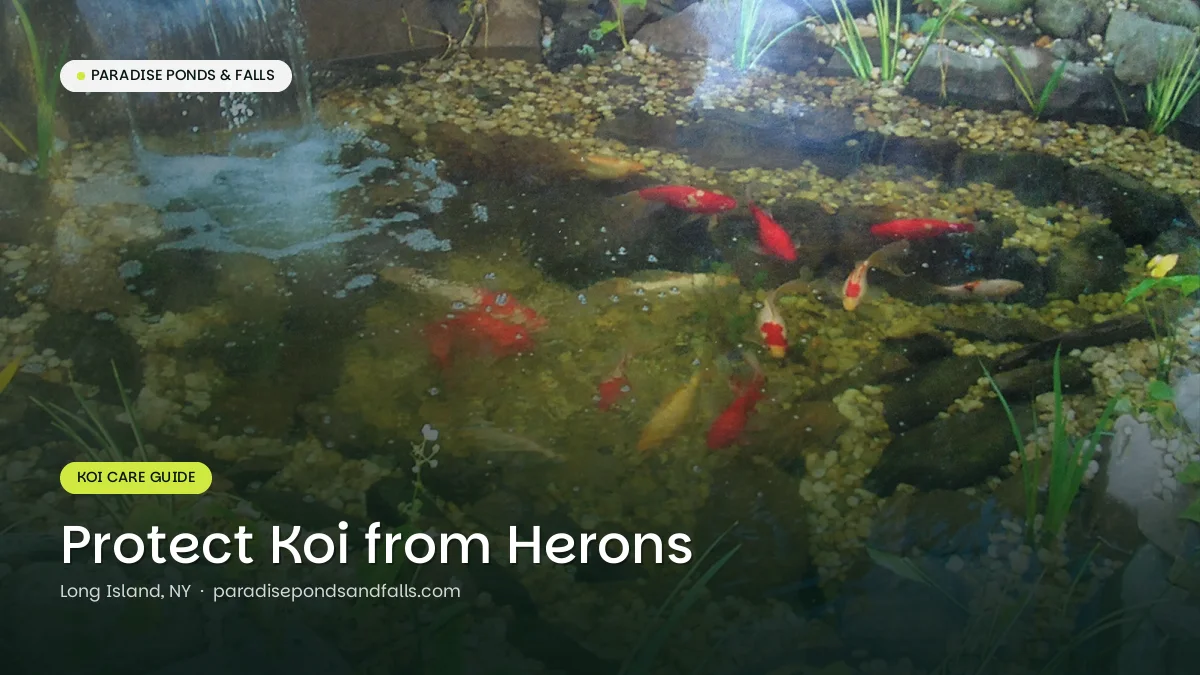
One morning the pond looks normal. The next week, half the koi are gone and the rest are hiding under the rocks. On Long Island, the usual culprit is the great blue heron: a patient, smart hunter that can take a fish in seconds and comes back to the same pond again and again. Here is how herons hunt, which deterrents actually work, and how to protect koi from herons for good.
To protect koi from herons, layer your defenses. Make the pond hard to fish with steep sides that drop into water at least 3 feet deep, give koi caves and overhangs to hide under, and add a motion-activated sprinkler to startle herons when they land. Use a pond net or a low perimeter line when herons are most active, and move any decoy every few days. No single trick works on its own for long.
How herons hunt your pond
Every good defense starts with how the bird behaves. Herons are not swimmers or divers. They are waders that stand still and strike.
They wade, they don't swim
A heron needs shallow water to stand in. Shallow shelves and gentle slopes are its fishing spots; deep water with steep sides is out of reach.
They hunt at dawn and dusk
Most visits happen early in the morning or around sunset, when the yard is quiet and nobody is outside to see them.
They land, then walk in
A heron usually lands on the lawn or the edge and walks to the water. That is why a low line around the edge can stop it.
They come back
Once a heron finds easy fish, it returns every day until the fish are gone or the pond stops being worth the trip.
Heron deterrents compared
Here is how the common heron deterrents for ponds stack up, from our experience on Long Island ponds and what pond owners report.
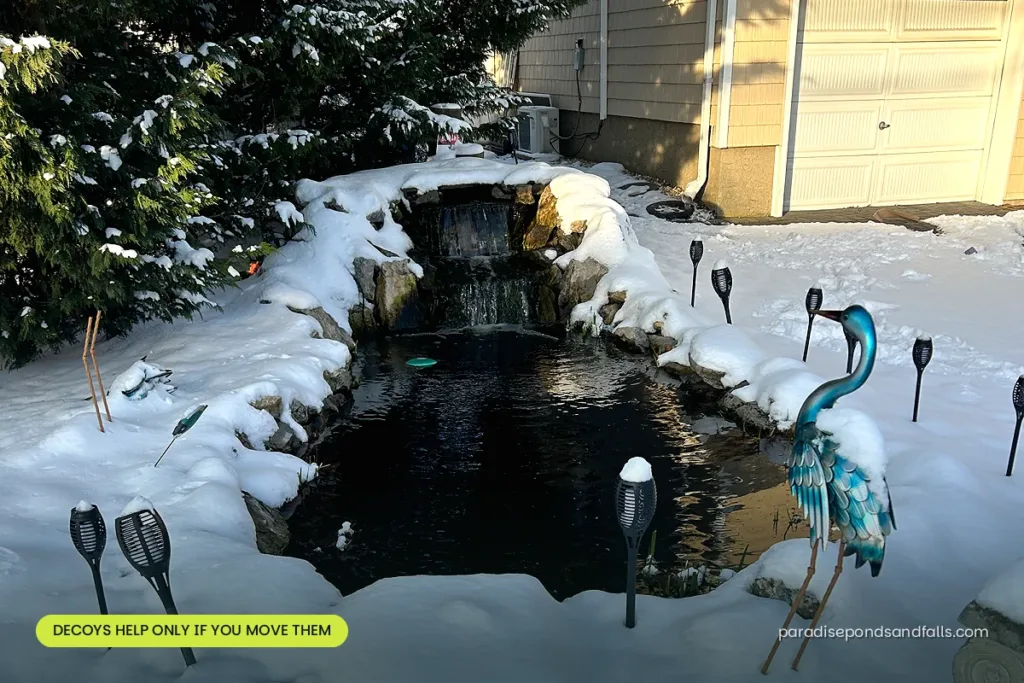 A decoy alone rarely lasts. Herons learn that a bird that never moves is not a threat.
Layer your defenses: a 3-step plan
Ponds that stay heron-free almost always use more than one layer. Start with the permanent fixes, then add the scare tactics.
Make the pond hard to fish
Design is the defense that never wears off. Keep planting shelves narrow, then drop steeply into a deep zone of at least 3 feet where koi can rest beyond the heron's reach. Avoid long, gently sloping beach edges near the deep water. If your pond is shallow everywhere, deepening part of it does more than any gadget. See how deep a koi pond should be.
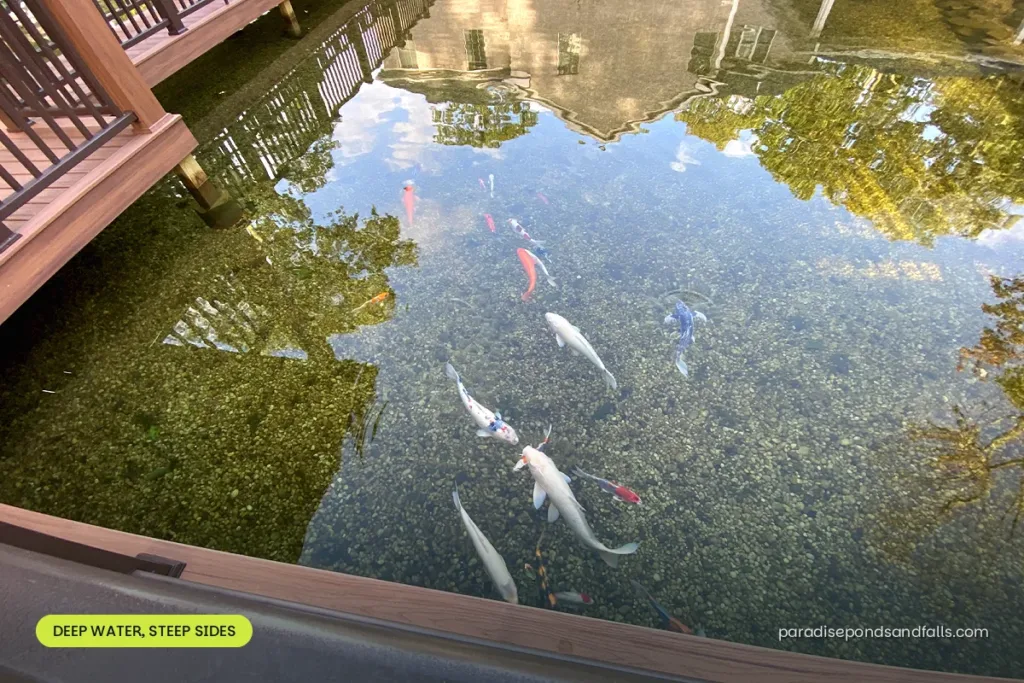 Deep, clear water with steep sides and an overhang gives a heron nowhere to stand.
Give koi somewhere to hide
Koi learn fast. If they have a fish cave, an overhanging rock ledge, a deck or a bridge to dart under, they scatter there the moment a shadow crosses the water. Water lily pads add cover on the surface too. Hiding places will not stop a visit, but they save fish when everything else fails.
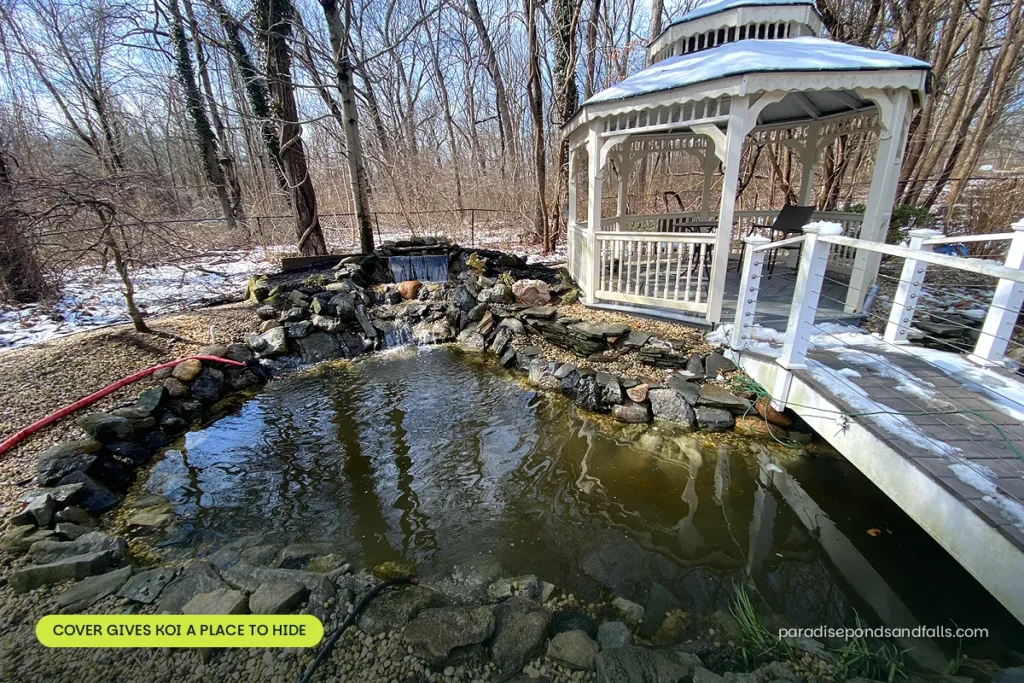 Bridges, ledges and decks double as shelters koi can dart under.
Add a surprise and a barrier
A motion-activated sprinkler aimed at the spots where herons land is the most reliable scare tactic, because the spray is sudden and different every time. Pair it with a barrier where you need it: a low line of fishing line or wire about a foot above the ground around the edge, or a pond net stretched tight above the water during the busiest months. If you use a decoy, move it every few days.
💡 The leaf net you put on in fall does double duty. It keeps leaves out and herons off at the time koi are slow and easiest to catch. Our guide on how to winterize a koi pond explains how to set it up so it sits above the water.Signs a heron has been visiting
Herons are rarely caught in the act. These clues usually show up first:
Fewer fish than last week, often the biggest or brightest ones Koi hiding and refusing to come up for food Scrapes, missing scales or puncture wounds on the fish that are left Flattened plants on the planting shelves where a bird stood Large three-toed footprints in the mud or mulch at the edgeWhen herons visit Long Island ponds
Great blue herons live around Long Island's marshes, creeks and harbors, and some stay all year. Backyard pond visits often pick up in spring and fall, when birds are on the move and young herons are learning to hunt. Ponds near the water on the North and South Shore tend to see more visits, but we have seen herons at ponds well inland in both Nassau and Suffolk.
If a heron injured your koi
Keep the water as clean as you can, with good aeration and no overfeeding, so small scrapes can heal. Watch the fish for a few days. Deep punctures or wounds that turn white or fuzzy need proper treatment, so call a koi health specialist or a vet who treats fish rather than guessing.
Paradise Ponds & Falls builds and rebuilds koi ponds across Nassau and Suffolk County with a deep zone, steep sides and built-in hiding spots, so your fish have a fighting chance without nets all year.
Clear water also helps koi see danger coming and reach cover in time. If your pond is cloudy, start with our guide to clearing green pond water, or see how an ecosystem pond keeps water clear naturally.
Herons and koi FAQs
Will a fake heron keep real herons away?
Sometimes, for a while. Herons can be territorial, so a decoy may make a visitor move on, but they soon learn that a bird that never moves is fake. Move it every few days and use it together with a sprinkler or a barrier.
How deep does a pond need to be to stop herons?
Depth works when it comes with steep sides. A deep zone of at least 3 feet, reached by a sharp drop rather than a gentle slope, gives koi a place the heron cannot wade to. Shallow shelves around the edge are where herons stand.
What time of day do herons eat koi?
Most often at first light and around dusk, when the yard is quiet. That is when a motion-activated sprinkler is most useful.
Does a pond net hurt fish or birds?
Not when it is set up properly. Stretch it tight so it sits above the water and does not sag in, and check it often so no bird or animal gets tangled.
Can I trap or remove a heron myself?
No. Great blue herons are protected under the federal Migratory Bird Treaty Act, so killing, trapping or harming them is illegal without a permit. Stick to deterrents that scare them off or keep them out.
Do koi caves really help?
Yes. Koi quickly learn to dart under a cave, ledge or deck when a shadow appears, which saves fish even when a heron gets past your other defenses.