

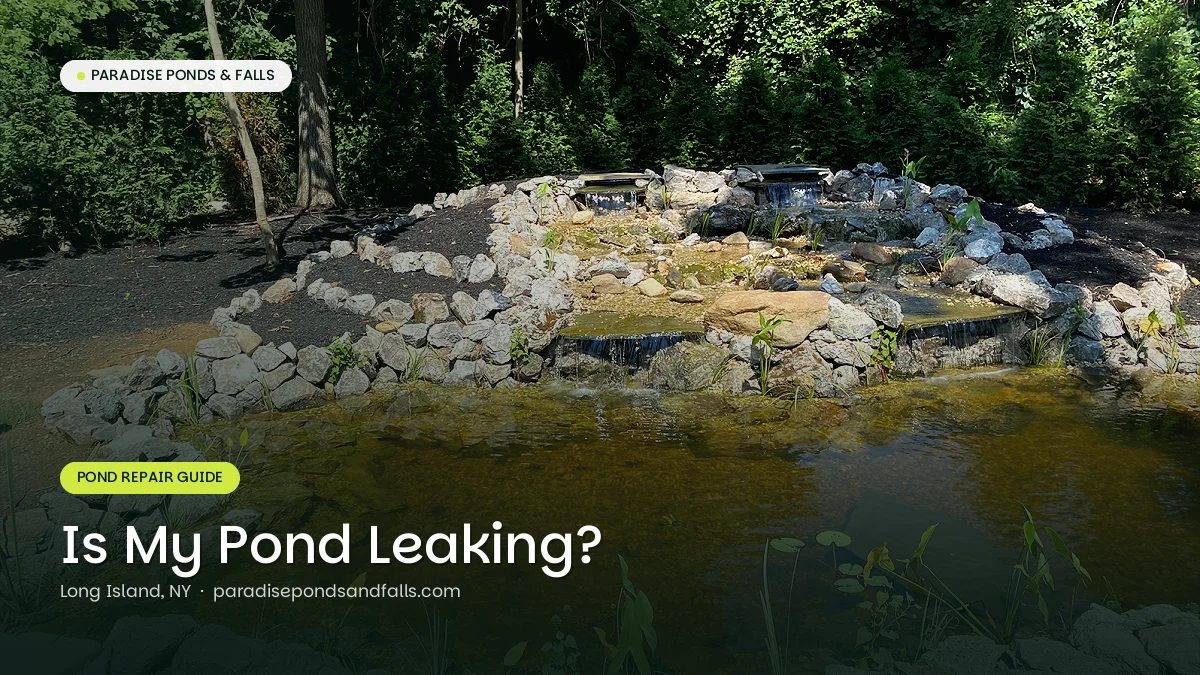
Is your pond leaking, or is it just evaporation? Every pond loses some water, so a dropping level does not always mean a leak. The trick is telling normal evaporation apart from a real leak, then narrowing down where the water is going before you start pulling rocks out. This guide walks through the same checks our crew uses on leaking ponds across Nassau and Suffolk County.
To tell if your pond is leaking, set a bucket of pond water on a step inside the pond, mark both water levels and compare them after 24 hours. If the pond drops more than the bucket, you have a leak. Then turn the pump off for a day: if the level stops dropping, the leak is in the waterfall, stream or plumbing. If it keeps dropping, the leak is in the pond itself, usually at the edge or at the height where the water finally stops going down.
Leak or evaporation? Do the bucket test first
Ponds lose water to evaporation every day, and more in hot, dry, windy weather or when a waterfall splashes a lot. Instead of guessing what is normal, compare your pond with a bucket that only loses water to evaporation:
- Top the pond up to its normal level and switch off any automatic fill valve.
- Fill a bucket with pond water and set it on a plant shelf or a stable rock inside the pond, so it sits at the same temperature.
- Mark both water lines: one inside the bucket, one on a rock or the liner at the pond edge.
- Wait 24 hours with the pump running as usual and no rain in the forecast.
- Compare. If both dropped about the same, it is evaporation. If the pond dropped more than the bucket, the difference is a leak.
Quick check: is my pond leaking?
Answer three questions to see where your pond is most likely losing water and what to check first.
The 6 places ponds leak most
In our experience, most pond leaks are not a hole in the middle of the liner. They are at the edges, in the stream or waterfall, or in the plumbing. Check these places before you think about draining anything.
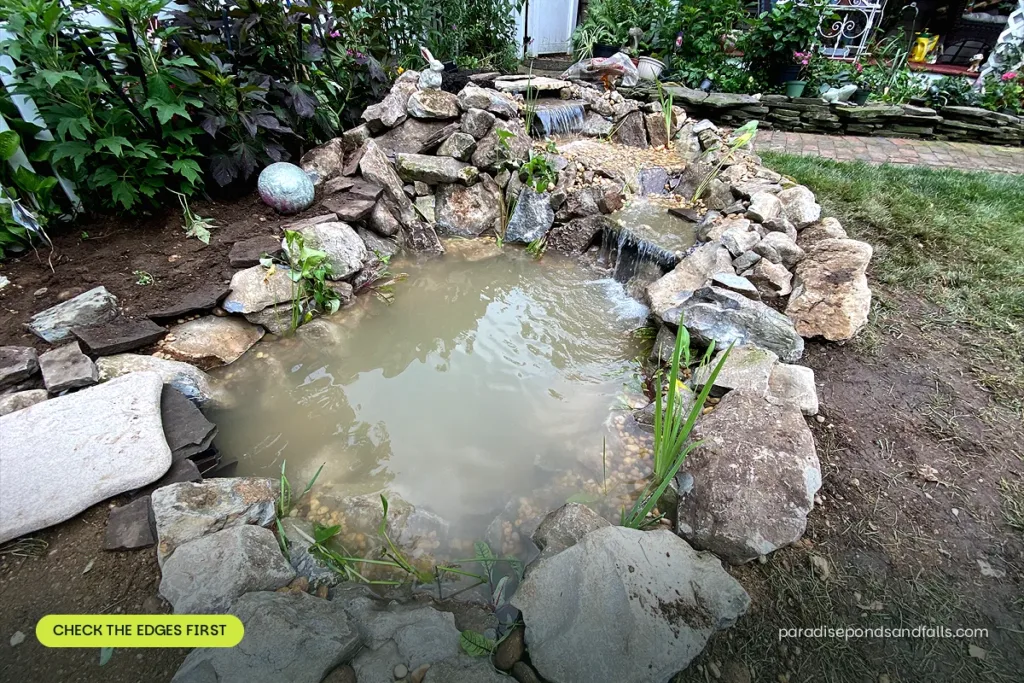 Edges settle over time. One low spot behind a rock is enough to let water run out.
1. A low spot at the edge
The soil around a pond settles, and rocks push the liner down. Water escapes over the low spot into the ground. Look for wet mulch, soggy soil or extra-green grass on one side.
2. The stream and waterfall
Water can splash past the edge, run under a stone or wick out where the liner sits too low along the stream. Leaves and roots can also build a dam that pushes water over the side.
3. Pump and plumbing fittings
Loose or cracked fittings at the pump, the check valve, the skimmer or the waterfall box leak slowly into the ground, often where you cannot see them.
4. Skimmer and waterfall box seals
Where the liner attaches to the skimmer or the biological waterfall box, the seal can loosen. Water runs behind the box instead of through it.
5. Holes in the liner
Sharp rocks, tree roots, animals digging at the edge or a dropped tool can puncture a liner. Older liners also get brittle and crack where they fold.
6. Plants wicking water out
Plant roots or mulch touching the water on the outside of the liner can wick water out like a sponge, slowly and steadily.
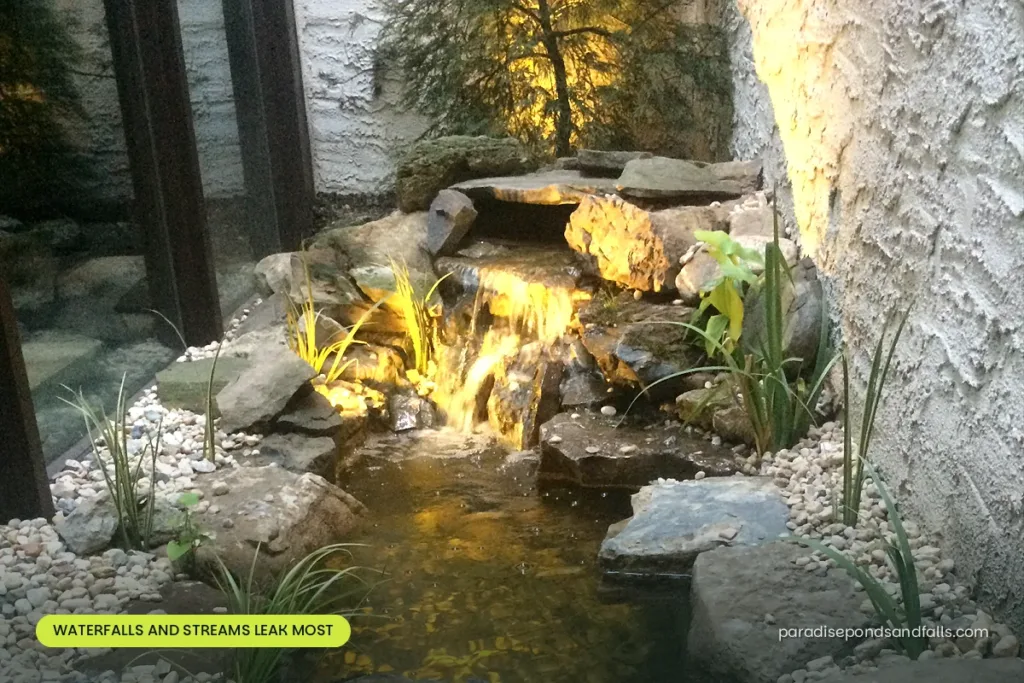 If the level only drops while the waterfall runs, start your search along the stream.
How to find a leak in a pond, step by step
Work through these steps in order. Each one rules out part of the pond, so you only dig where you need to.
Confirm it is a leak
Do the bucket test above. Pick a dry spell, because rain makes the ground wet and hides the signs you are looking for.
Turn the pump off for 24 hours
Top up the pond, mark the level and turn the pump off. Keep fish well aerated with an air pump if the weather is warm. If the level holds, the leak is in the waterfall, stream or plumbing. If it keeps dropping, the leak is in the pond basin.
Walk the stream and the edges
With the pump running again, walk slowly along the stream and the pond edge. Look for water running under stones, wet soil beside the liner and places where the liner edge sits below the water line. Fix these first: most leaks end here.
Let the level drop and watch where it stops
If the pond basin is leaking, leave the pump off and let the water fall on its own. It stops dropping at the height of the hole. Search along that line for punctures, a loose seal or a fold in the liner.
Use a dye or milk test to pinpoint it
Once you know roughly where to look, turn everything off so the water is still, then squeeze a little milk or pond-safe dye near the suspect spot. If it drifts toward one place, that is your hole. This only works when you are already close to the leak. Pond equipment maker Aquascape lays out the same order of checks in its guide to finding a leak in a water feature.
What the water level tells you
How and when the level drops usually points straight to the cause. Use this table to decide where to look first.
Can you fix a pond leak yourself?
Many leaks are simple fixes once you find them. Others are a sign that the pond needs more than a patch.
Usually a DIY fix
- Raising a low liner edge and adding soil behind it
- Resetting stones in the stream so water stays inside
- Clearing a leaf or root dam in the stream
- Tightening a loose fitting at the pump
- Patching a single small hole with a liner repair kit
Time to call a pro
- You cannot find the leak after the pump-off test
- The pond drops several inches a day
- The skimmer or waterfall box seal is leaking
- The liner is brittle, cracked or has many holes
- Fish are stressed and you need the pond stable fast
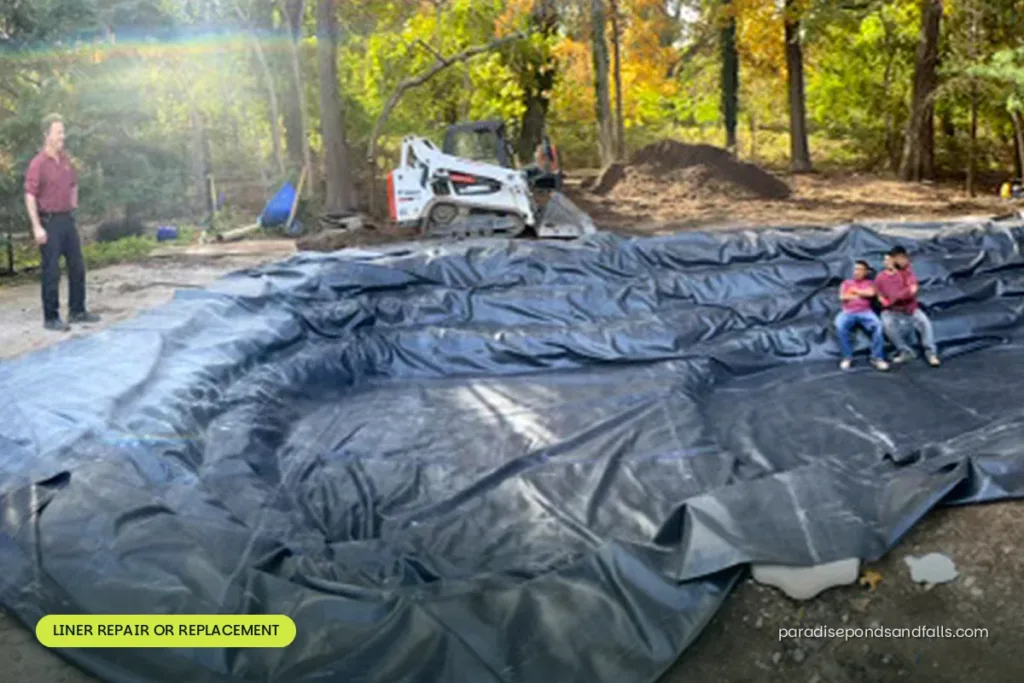 When a liner is past patching, a new liner is also the time to fix depth, edges and filtration.
Repair or replace? Patch a single hole or a short tear. Replace the liner when it is brittle, has several holes or keeps leaking after repairs. A full reline means moving the fish, removing rocks and rebuilding the edges, so it is also the right moment to correct a pond that was built too shallow. See how deep a koi pond should be before you rebuild.
⚠️ Keep your fish safe while you search. Never let the water drop below about half the pond's depth with fish inside, keep an air pump running, and add a dechlorinator every time you top up with tap water. If the level is falling fast, move the fish to an aerated holding tank.Pond leaks in a Long Island winter
Not every winter water loss is a leak. Ice can build up in a stream or on a waterfall and push water over the edge, and a frozen auto-fill line cannot top the pond up. If your pond drops during a cold snap, check the stream for ice dams first. Our guide on how to winterize a koi pond explains when to shut the waterfall down for the season.
Paradise Ponds & Falls has repaired and rebuilt ponds across Long Island for over 20 years. We track down leaks in edges, streams, waterfalls, plumbing and liners, and we keep your fish safe while we work.
Most leaks start small. A yearly spring pond cleanout and regular pond maintenance catch sinking edges, loose fittings and stream dams before they cost you water.
Pond leak FAQs
How much water loss is normal for a pond?
It depends on the sun, heat, wind and how much your waterfall splashes, so there is no single number. Do the bucket test instead: if the pond drops more than a bucket of pond water sitting in it over the same 24 hours, the extra loss is a leak.
Why is my pond losing water but I can't find a leak?
The most common hidden spots are a low edge behind rocks or plants, a stream where water runs under the stones, and a slow plumbing leak at the pump or skimmer. Turn the pump off for 24 hours to find out whether the leak is in the waterfall side or the pond itself.
Can a pond leak be fixed without draining it?
Often, yes. Edge leaks and stream leaks are fixed by raising the liner or resetting stones with the pond full. A hole low in the liner usually needs the water lowered to that point so a patch can bond to dry liner.
Does the milk test really work for finding a pond leak?
It can show water being pulled toward a hole, but only when the water is completely still and you are already close to the leak. Use it after the level test has told you which area and which height to search.
Should I repair or replace my pond liner?
Repair a single hole or a small tear with a liner patch kit. Replace the liner when it is brittle, cracked in several places or keeps leaking after repairs. A replacement is also a good time to fix depth, edges and filtration.
Is it OK to keep topping up a leaking pond?
Small top-ups for a few days are fine while you search, as long as you add a dechlorinator. Large daily refills change the water chemistry, hide the problem and can wash out the soil under the liner, so find and fix the leak as soon as you can.